
 boxing equipment collection-guide-inbody.jpg?v=1771474769" alt="How to Choose ApexWolf Core Boxing Gloves - ApexWolf" style="max-width:100%;border-radius:8px;margin-bottom:30px;">
Buying boxing gloves isn't a casual purchase. The wrong pair compromises your wrist integrity, limits your training output, and accelerates hand fatigue. The right pair becomes an extension of your fist — protective, responsive, and built to last through thousands of rounds.
This guide breaks down everything you need to know: glove types, sizing by weight class, material differences, closure systems, hand wrapping fundamentals, and a direct comparison of our three boxing glove lines. No filler. Just the information you need to make a decision.
Choosing the right boxing gloves depends on your training style: 12oz for bag work and pad drills, 14oz for sparring lighter fighters, and 16oz for heavy sparring — with leather gloves lasting significantly longer than synthetic options.
Types of Boxing Gloves
Not all gloves serve the same purpose. Understanding the categories prevents you from training with the wrong equipment.
Bag Gloves (8–12 oz)
Compact, lighter padding. Designed for heavy bag and speed bag work where you need to feel the impact point. Less wrist protection than sparring gloves — not meant for hitting another person. Ideal for developing punch accuracy and building knuckle conditioning.
Training Gloves (12–16 oz)
The all-rounders. Enough padding for bag work, enough protection for light sparring. If you're buying one pair, this is the category. Most fighters keep a dedicated training pair for daily gym sessions.
Sparring Gloves (14–18 oz)
Maximum padding to protect both you and your training partner. Most gyms mandate 16 oz minimum for sparring. The extra weight builds shoulder endurance — a side benefit that pays off in later rounds during competition.
Competition Gloves (8–10 oz)
Lighter, less padding, more transfer of force. Sanctioned by federations for amateur and professional bouts. Not for daily training — reserved for fight night. The specific weight is determined by your weight class and the governing body.
How to Choose the Right Size: The Complete Sizing Guide
Boxing glove sizing is measured in ounces (oz), which refers to the weight of padding — not the physical size of the glove. More ounces means more padding, more protection, and more weight on your hands.
Size by Body Weight
| Glove Size | Fighter Weight | Best For |
|---|---|---|
| 8 oz | Under 120 lbs | Competition only |
| 10 oz | 120–150 lbs | Bag work, pad work |
| 12 oz | 150–180 lbs | All-around training, bag work |
| 14 oz | 180–210 lbs | Sparring, heavy bag |
| 16 oz | 210+ lbs | Sparring, heavy bag, maximum protection |
| 18 oz | Any weight | Extra protection sparring |
How to Measure Your Hand
If you're between sizes or ordering online, measure your hand circumference:
- Wrap a flexible tape measure around your dominant hand just below the knuckles (exclude the thumb).
- Make a loose fist and note the measurement.
- Use this as a secondary reference alongside your body weight.
| Hand Circumference | Suggested Glove Size |
|---|---|
| 5.5"–6.5" | 8–10 oz |
| 6.5"–7.5" | 12 oz |
| 7.5"–8.5" | 14–16 oz |
| 8.5"+ | 16–18 oz |
Important: Hand wraps add approximately 0.25"–0.5" to your hand circumference. Always try gloves on with wraps. If you use Mexican-style wraps (180"), expect more bulk than standard 120" wraps. Your gloves should feel snug with wraps on — not loose, not compressing your knuckles.
Which Oz for Which Activity — Quick Reference
| Activity | Recommended Size | Notes |
|---|---|---|
| Bag Work | 10–14 oz | Lighter = more speed feel; heavier = more wrist protection |
| Pad Work | 10–14 oz | Match to your bag gloves for consistent technique |
| Sparring | 14–18 oz | Most gyms require 16 oz minimum — check house rules |
| Competition | 8–10 oz | Federation-dependent; weight class determines exact oz |
Our full product size guides are available on each product page. See the Core Gloves Size Guide Edge Pro Size Guide Pulse Size Guide pages for variant-specific measurements.
Material Breakdown: Leather vs. Synthetic
Genuine Leather
Conforms to your hand shape over time. Superior durability — a quality leather glove can last 3–5 years with proper care. Breathes better than synthetic. Higher price point, but the cost-per-session math favors leather for serious fighters training 4+ days per week.
Synthetic Leather (PU)
Modern PU leather has closed the gap significantly. Easier to clean, lighter out of the box, and more consistent in quality. Won't develop the same personalized break-in as genuine leather, but premium PU (like the materials used in ApexWolf gloves) delivers professional-grade performance at a more accessible price. Ideal for fighters who rotate gloves or train across multiple disciplines.
The Verdict
For most fighters — especially those building a collection — high-grade PU synthetic offers the best value-to-performance ratio. Save genuine leather for your competition pair.
Closure Types
Velcro (Hook-and-Loop)
The standard for training. You can put them on and take them off without help. Adjustable tension. Faster transitions between rounds. Every ApexWolf glove uses reinforced Velcro closures for this reason — it's the practical choice for daily training.
Lace-Up
Tighter, more customized fit. Common in competition. The drawback: you need someone to lace you up. Some fighters use lace-up converters (a hybrid solution), but for gym training, Velcro dominates for good reason.
Hand Wrapping Basics
Gloves protect the outside of your hand. Wraps protect the inside — the 27 small bones, tendons, and ligaments that absorb force with every punch.
- Standard wraps (120"): Basic protection. Good for bag work and light training.
- Mexican-style wraps (180"): Semi-elastic, more coverage. Preferred by most fighters for the tighter, more supportive wrap.
- Gel inner gloves: Quick-wrap alternative for casual training. Less customizable than traditional wraps but faster to put on.
Non-negotiable rule: Always wrap your hands before putting on gloves. Even for a 10-minute bag session. The one time you skip wraps is the time you sprain a wrist or fracture a metacarpal. It's not worth it.
The ApexWolf Boxing Glove Lineup
Three tiers. Same commitment to protection and durability. Different feature sets for different fighters. Here's the breakdown using actual specifications from each product.

Pulse Professional Boxing Gloves — $38.50 CAD
The entry point for serious training.
The Pulse line delivers professional-grade protection at the most accessible price in the lineup. Designed for fighters who want reliable equipment without overinvesting while building their skills.
| Specification | Detail |
|---|---|
| Material | Shine Pindot PU synthetic leather — smooth, rich finish |
| Color | Black base with red accents and ApexWolf branding |
| Padding | RF01 high-density foam for optimal hand protection |
| Closure | Adjustable Velcro strap for wrist stability |
| Construction | Reinforced stitching for extended durability |
| Lining | Sweat-wicking inner for comfort and hygiene |
| Sizes | 8 oz, 10 oz, 12 oz, 14 oz, 16 oz |
Key Features:
- Bold black and red aesthetic with ApexWolf branding
- Multi-layer shock-absorbing foam reduces knuckle fatigue
- Secure Velcro wrist strap — snug fit on every punch
- Anatomically formed interior promotes natural fist position
- Breathable inner fabric pulls moisture away during intense sessions

Core Boxing Gloves — $41.99 CAD
The workhorse. Built for daily punishment.
The Core sits at the center of the lineup — the glove most ApexWolf fighters reach for on a daily basis. Clean aesthetics, reliable padding, and a fit that breaks in without breaking down.
| Specification | Detail |
|---|---|
| Material | Tough matte PU leather — professional appearance |
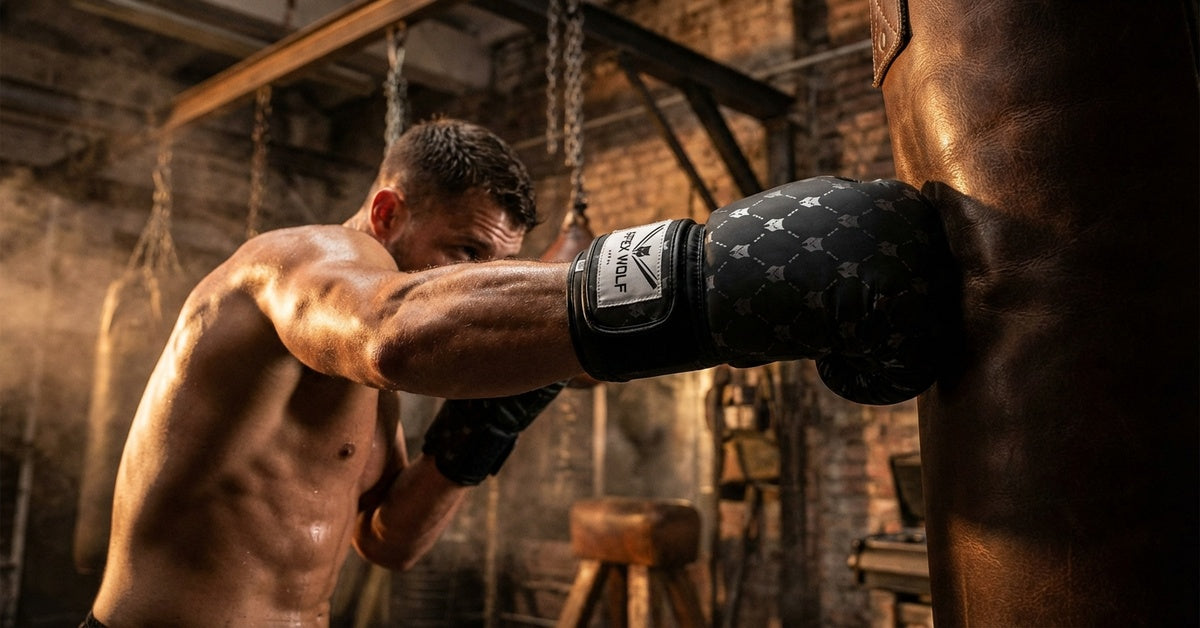
| Color | All black with grey ApexWolf logo pattern |
| Padding | High-density machine-injected foam for maximum shock absorption |
| Closure | Adjustable Velcro wrist strap |
| Design | Anatomically shaped hand compartment with thumb lock |
| Lining | Moisture-wicking interior for sustained comfort |
| Sizes | 8 oz, 10 oz, 12 oz, 14 oz, 16 oz |
Key Features:
- Matte black finish with subtle logo pattern — clean, tactical aesthetic
- Machine-injected foam delivers consistent impact absorption across the striking surface
- Reinforced Velcro strap provides wrist stability and injury prevention
- Flexible, ergonomic fit reduces hand fatigue during extended sessions
- Moisture-wicking lining keeps hands cool and dry under pressure

Edge Pro Boxing Gloves — $44.50 CAD
The top tier. Maximum protection, premium build.
The Edge Pro represents the highest spec in the ApexWolf glove lineup. Multi-layer foam construction, ventilated palm design, and the widest wrist strap in the collection. Built for fighters who train hard and need gear that keeps pace.
| Specification | Detail |
|---|---|
| Material | Tough matte PU leather — professional-grade |
| Color | Black with bright orange accents and ApexWolf branding |
| Padding | Thick foam mold — multi-layer construction for superior impact absorption |
| Closure | Adjustable Velcro wrist strap — extra-wide |
| Lining | Soft moisture-wicking fabric for extended comfort |
| Wrist Support | Broad Velcro strap for enhanced stability and protection |
| Ventilation | Palm mesh airflow system — keeps hands cool |
| Sizes | 8 oz, 10 oz, 12 oz, 14 oz, 16 oz |
Key Features:
- Premium leather exterior built to handle high-volume training
- Multi-layer foam padding system absorbs impact and reduces hand fatigue
- Extra-wide hook-and-loop strap delivers the tightest, most secure wrist lockdown
- Anatomically shaped hand compartment supports natural fist alignment
- Ventilated palm mesh keeps hands cool and dry during high-intensity rounds
Head-to-Head Comparison
| Feature | Pulse ($38.50) | Core ($41.99) | Edge Pro ($44.50) |
|---|---|---|---|
| Material | Pindot PU | Matte PU | Matte PU |
| Padding | RF01 High-Density | Machine-Injected HD | Multi-Layer Foam Mold |
| Wrist Strap | Standard Velcro | Standard Velcro | Extra-Wide Velcro |
| Ventilation | Wicking Lining | Wicking Lining | Palm Mesh + Wicking |
| Thumb Lock | Standard | Integrated | Integrated |
| Best For | Starting out, pad work | Daily training, bag work | Heavy sparring, advanced training |
Frequently Asked Questions
What size boxing gloves do I need for beginners?
Start with 12 oz or 14 oz depending on your body weight. These sizes offer enough padding to protect your hands while you develop proper technique. Refer to the size chart above — match your weight to the recommended oz range. When in doubt, go heavier. Extra padding never hurt anyone; insufficient padding has.
Can I use the same gloves for bag work and sparring?
You can, but you shouldn't make a habit of it. Bag work compresses padding faster, which reduces the protection available for sparring. If budget allows, keep a dedicated sparring pair (14–16 oz) and a separate bag pair (10–12 oz). Your hands and your training partners will thank you.
How often should I replace boxing gloves?
With regular training (3–5 sessions per week), expect 12–18 months from a quality pair. Signs it's time: the padding feels flat or uneven, the Velcro doesn't grip, the lining is peeling, or your hands hurt more after sessions. Don't wait for a complete breakdown — compromised padding means compromised protection.
Do I need hand wraps with boxing gloves?
Yes. Every single time. Hand wraps stabilize the small bones in your hand and wrist, absorb sweat (extending glove life), and provide an additional layer of padding across the knuckles. This is non-negotiable equipment, not an optional accessory.
What's the difference between 12 oz and 16 oz gloves?
Four ounces of additional padding. That translates to more wrist protection, more knuckle cushioning, and more weight on your hands. 12 oz is ideal for bag work and technique drills. 16 oz is the sparring standard — the extra padding protects both you and your partner during live rounds. The added weight also builds shoulder endurance over time.
How do I know if my gloves fit correctly?
With hand wraps on: your fingers should reach the end of the glove without cramping, your hand should feel snug (not squeezed), and the Velcro strap should close with firm tension across your wrist. If there's dead space at the fingertips or your hand slides inside the glove, size down. If your knuckles feel compressed, size up.
Care Guide: Making Your Gloves Last
Boxing gloves are a breeding ground for bacteria if neglected. Proper care extends the lifespan of your gear and prevents the smell that clears out a locker room.
- After every session: Open the Velcro, spread the cuff wide, and air them out. Never leave gloves sealed in a gym bag.
- Wipe down: Use a damp cloth with mild antibacterial soap on the interior after each use. Let them dry completely before storage.
- Deodorize: Stuff with cedar blocks, newspaper, or purpose-built glove deodorizers. Baking soda packets work in a pinch.
- Avoid direct heat: Don't put gloves on radiators, in dryers, or in direct sunlight. Heat degrades PU leather and breaks down foam padding. Air dry at room temperature.
- Condition the exterior: Wipe the outer shell with a leather conditioner or PU-safe cleaner once a month to prevent cracking and maintain flexibility.
- Rotate pairs: If you train daily, two pairs in rotation will each last significantly longer than one pair used every session. The rest period allows padding to fully decompress and moisture to evaporate.
Final Word
The right boxing gloves match your training style, your weight class, and your goals. Don't overthink it — but don't underthink it either. Use the size chart, understand what you're training for, and invest in equipment that protects your most valuable tools.
Every glove in the ApexWolf lineup is engineered for the same standard: protection that performs, session after session. The only question is which tier matches your training demands.
Free shipping on orders over $50 across Canada and the US.
Share:
Essential Lifting Accessories for Serious Lifters — Straps, Grips, Wraps & Hooks
Best Oversized Gym Tees for Women in Canada [2026 Guide]