
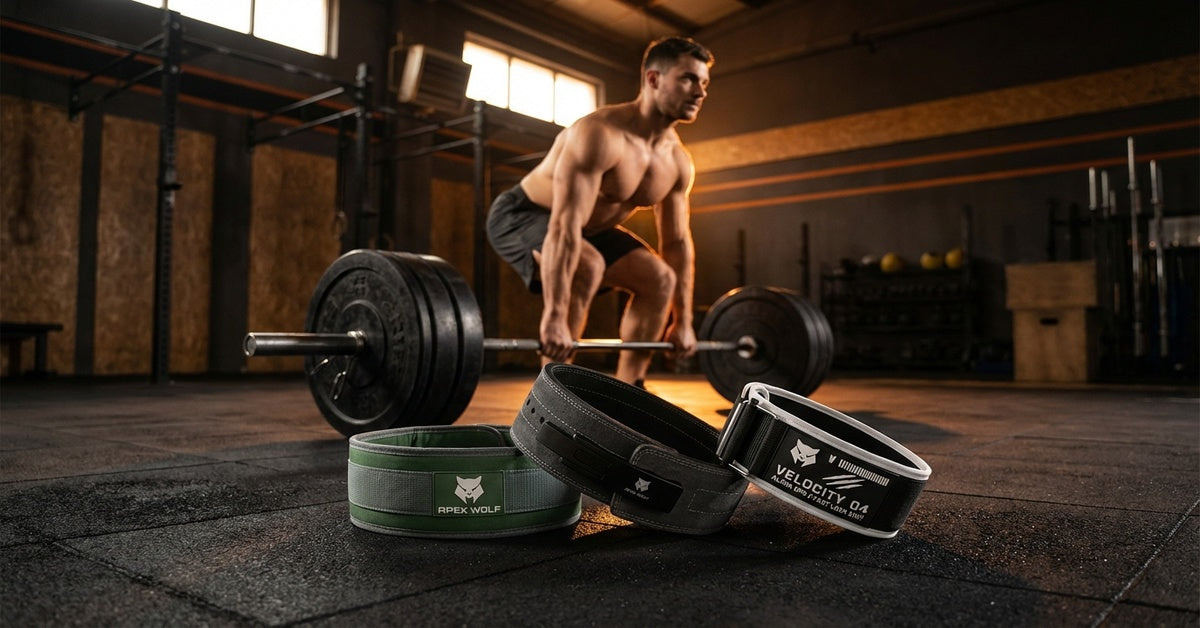
 weightlifting belts collections Guide - ApexWolf" style="max-width:100%;border-radius:8px;margin-bottom:30px;">
Choosing the wrong weightlifting belt doesn't just cost you money — it costs you performance. The right belt creates intra-abdominal pressure that stabilizes your spine under load. The wrong one either restricts your movement, slips mid-lift, or gives you a false sense of security with zero actual support.
Whether you're grinding through a 5x5 squat program, chasing a deadlift PR, or pushing through high-rep CrossFit WODs, your belt choice matters. This guide breaks down the three main belt types — lever, prong, and Velcro — explains what each one actually does, and helps you pick the right one for your training style.
The three main types of weightlifting belts are Alpha Power Lever Belts (fastest to tighten, best for powerlifting), prong belts (most adjustable, best for general lifting), and Velcro belts (most comfortable, best for CrossFit and high-rep training).
What Does a Weightlifting Belt Actually Do?
A lifting belt doesn't "hold your back together." That's a common misconception. What it actually does is give your abdominal muscles something to brace against. When you take a deep breath and push your abs outward into the belt, you create intra-abdominal pressure (IAP). This pressure stabilizes your spine from the inside out, allowing you to handle heavier loads safely.
Think of it like inflating a tire inside your core. Without the belt, the air (pressure) dissipates. With the belt providing resistance, the pressure builds and locks your torso into a rigid column. The result: more force transfer, less spinal flexion, bigger lifts.
The Three Belt Types Explained
1. Lever Belts — Maximum Rigidity, Instant Lock
Lever weightlifting belts use a metal latch mechanism for instant on/off tightening, making them the preferred choice for powerlifters in Canada who need consistent, maximum tightness during heavy squats and deadlifts.
Lever belts use a metal lever mechanism that snaps shut for an extremely tight, consistent fit. Once locked, there's zero give — the belt stays at the exact tightness you set. This makes them the gold standard for powerlifting, where maximum rigidity equals maximum support.
Pros:
- Fastest on/off — flip the lever, done
- Most consistent tightness rep to rep
- Maximum rigidity for heavy singles and low-rep work
- Full grain leather builds character over time
Cons:
- Fixed sizing — changing the fit requires a screwdriver to move the lever position
- Break-in period — stiff leather needs weeks to mold to your body
- Heavier and bulkier than nylon alternatives
- Not ideal for dynamic movements (cleans, snatches) due to rigidity
Best for: Powerlifting, heavy squats, heavy deadlifts, bench press, anyone prioritizing maximum support over flexibility.
2. Prong Belts — Traditional, Adjustable, Competition-Legal
Prong weightlifting belts use a traditional buckle system with single or double prongs, offering the most adjustability for lifters whose waist size fluctuates between bulking and cutting phases.
Prong belts (single or double prong) use a traditional buckle system similar to a regular belt. They're the most universally accepted belt type in competitive powerlifting federations (IPF, USAPL, CPU). Single prong is generally preferred over double — easier to get on and off with no real difference in security.
Pros:
- Micro-adjustable — move between prong holes for different lifts
- Universally competition-legal across all federations
- Durable leather construction
- Simple mechanism with nothing to break
Cons:
- Slower on/off compared to lever or Velcro
- Can be difficult to secure at maximum tightness alone
- Same break-in period as lever belts
- Double prong versions are unnecessarily difficult
Best for: Competition powerlifters, lifters who vary tightness between squat and deadlift, those who want a simple, no-frills belt.
3. Velcro/Nylon Belts — Speed, Flexibility, Versatility
Velcro belts use industrial-strength hook-and-loop closures, often paired with a steel roller buckle for added security. They're lighter, more flexible, require zero break-in, and adjust infinitely within your size range.
Pros:
- Fastest adjustment — wrap, pull, lock
- No break-in period — comfortable from day one
- Lightweight and packable
- Infinite adjustability within size range (no fixed holes)
- Better for dynamic movements and varied training
Cons:
- Less rigid than leather — not ideal for absolute max singles
- Velcro can wear over time (cleanable and maintainable)
- Not legal in most powerlifting federations
- Requires occasional Velcro maintenance
Best for: CrossFit, Olympic lifting, functional fitness, bodybuilding, high-rep training, anyone who values speed and versatility.
When to Use a Belt (And When Not To)
Use a belt when:
- Squatting or deadlifting above 80% of your max
- Performing heavy overhead presses
- Doing heavy barbell rows
- Any compound lift where spinal loading is significant
Don't use a belt when:
- Warming up — build bracing strength unbelted first
- Doing isolation exercises (curls, lateral raises)
- You haven't learned proper bracing technique yet — the belt amplifies good technique, it doesn't replace it
- Light accessory work — save the belt for when you actually need it
How to Size a Weightlifting Belt
Measure around your natural waist at navel level — not your pants size. Stand relaxed, don't flex or suck in. Use a flexible tape measure and note the number in inches.
- XS: 24–28"
- S: 28–32"
- M: 32–36"
- L: 36–40"
- XL: 40–44"
If you're between sizes, size down for lever belts (they don't adjust) and stay true for Velcro belts (infinite adjustment within range). Check our detailed size guides for product-specific measurements.
The ApexWolf Lineup — Compared
We carry four distinct weightlifting belts, each designed for a different training style. Here's how they compare:

Alpha Power Lever Belt — $59.99 CAD
"Designed for Elite Powerlifters"
The Alpha Power is a 13mm full grain leather lever belt built for serious strength athletes. The stainless steel lever mechanism locks instantly and holds under maximum loads. Suede finish interior grips your shirt and prevents rotation during lifts. Reinforced double stitching throughout.
- Type: Lever
- Material: Full grain natural leather, suede finish
- Thickness: 13mm
- Width: 4 inches (uniform)
- Closure: Stainless steel lever mechanism
- Sizes: S, M, L, XL
- Colors: Black, Green, Red, White
- Best for: Powerlifting, heavy squats, heavy deadlifts, bench press

Flex Core Lifting Belt — $31.99 CAD
"Engineered for lifters who refuse to compromise stability for mobility."
The Flex Core features a 10mm high-density foam core with a 6-inch lumbar panel that contours to your spine while maintaining structural integrity under load. The tapered 4-inch front allows full hip flexion during deep squats. Steel roller buckle with industrial Velcro ensures zero slippage.
- Type: Nylon/Foam with Velcro + steel buckle
- Core: 10mm high-density foam
- Back Width: 6 inches
- Front Width: 4 inches (tapered)
- Closure: Steel roller buckle + industrial Velcro
- Interior: Moisture-wicking soft-touch liner
- Sizes: S, M, L, XL
- Colors: Iron Forest (Green), Tactical Pink
- Best for: Compound lifts, CrossFit, functional training, anyone wanting flexibility with support

Stealth Flex Weightlifting Belt — $39.99 CAD
"Lock in. Brace hard. Move free."
The Stealth Flex delivers reliable core support with a quick-adjust dual-security closure. Metal roller buckle combined with industrial-strength Velcro for maximum security. Double-stitched seams, corrosion-resistant hardware, and a padded interior that reduces pressure points during heavy lifts. Lightweight (~200g) and packs flat in any gym bag.
- Type: Reinforced nylon with Velcro + metal buckle
- Width: Uniform throughout
- Closure: Dual-lock (metal roller buckle + Velcro strap)
- Hardware: Rust-proof metal
- Interior: Padded cushioned lining
- Weight: ~200g (lightweight)
- Sizes: S, M, L, XL
- Colors: Black/Green, Black/Pink
- Best for: CrossFit, strength training, functional fitness, high-rep work

Velocity 04 Weightlifting Belt — $39.99 CAD
"Fast lock. Full support. Zero compromise."
The Velocity 04 combines industrial Velcro grip with a steel roller buckle for the ultimate fast-lock system. 4-inch uniform width delivers consistent pressure around your entire midsection. Contrast white edge binding and ALPHA OPS // FAST LOCK UNIT branding give it a distinctive tactical look. The Fast Lock mechanism releases instantly — no fumbling with prongs or levers.
- Type: Heavy-duty reinforced nylon with Velcro + steel roller
- Width: 4 inches (uniform)
- Closure: Fast Lock (Velcro + steel roller buckle)
- Edge Trim: Contrast white binding
- Interior: Textured grip lining
- Hardware: Steel roller release mechanism
- Sizes: XS, S, M, L, XL
- Colors: Arctic White
- Best for: Squats, deadlifts, Olympic lifts, CrossFit, bodybuilding
Quick Comparison Table
| Feature | Alpha Power | Flex Core | Stealth Flex | Velocity 04 |
|---|---|---|---|---|
| Price | $59.99 | $31.99 | $39.99 | $39.99 |
| Type | Leather Lever | Nylon/Foam | Nylon | Nylon |
| Closure | Lever | Buckle + Velcro | Buckle + Velcro | Fast Lock |
| Thickness | 13mm | 10mm foam | Standard | Standard |
| Width | 4" uniform | 6" back / 4" front | Uniform | 4" uniform |
| Best For | Powerlifting | Versatile/CrossFit | Functional | Speed training |
| Break-in | Yes (leather) | None | None | None |
| Competition Legal | Yes (most feds) | No | No | No |
How to Care for Your Belt
Leather Belts (Alpha Power)
- Clean: Hand wash only. Wipe with damp cloth after use.
- Dry: Air dry away from direct heat.
- Store: Hang or lay flat. Don't roll tightly — leather can crease.
- Avoid: Machine washing, soaking, direct sunlight for extended periods.
Nylon/Velcro Belts (Flex Core, Stealth Flex, Velocity 04)
- Clean: Wipe down with a damp cloth after each use to remove sweat and chalk. For deeper cleaning, hand wash with mild soap and lukewarm water. Gently scrub Velcro to remove debris.
- Dry: Air dry completely before storing. Do not machine dry — heat damages Velcro adhesion and nylon fibers.
- Store: Roll loosely or hang by the buckle. Do not fold sharply or store compressed.
- Avoid: Machine washing, bleach, fabric softeners, prolonged sun exposure, and storing while damp or sweaty.
- Velcro maintenance: If Velcro loses grip, use a stiff brush or fine-tooth comb to clean out lint, hair, and debris from the hook side. Always close the Velcro when not wearing the belt to prevent snagging.
Frequently Asked Questions
How do I choose between lever and Velcro?
If you're a competitive powerlifter focused on 1–3 rep maxes, go lever (Alpha Power). If you train across multiple disciplines, change tightness between lifts, or want zero break-in time, go Velcro (Flex Core, Stealth Flex, or Velocity 04).
Is a belt considered cheating?
No. A belt doesn't lift the weight for you — it gives your core muscles a surface to brace against, making your own bracing more effective. Every competitive powerlifter and most serious strength athletes use a belt for heavy work.
Can I use a Velcro belt for squats and deadlifts?
Absolutely. Nylon Velcro belts provide serious support for compound lifts. The Flex Core's 10mm foam core and 6-inch back panel deliver substantial lumbar support. The key difference from leather is flexibility, not effectiveness.
What's the difference between the Flex Core, Stealth Flex, and Velocity 04?
The Flex Core ($31.99) has a tapered design with wider 6" back support — best for those wanting maximum lumbar coverage with front flexibility. The Stealth Flex ($39.99) is a uniform-width padded belt focused on comfort and lightweight portability. The Velocity 04 ($39.99) features the Fast Lock system with a distinctive tactical design — best for speed between sets.
How long does a lifting belt last?
With proper care, a leather lever belt lasts 10+ years. Nylon/Velcro belts typically last 2–3+ years of regular training. The main thing that reduces Velcro lifespan is debris buildup — keep it clean and it'll last significantly longer.
The Bottom Line
There's no single "best" belt — there's the best belt for your training. Powerlifters go leather lever. CrossFitters and functional athletes go nylon Velcro. Everyone else falls somewhere in between.
What matters is that you're bracing correctly, sizing properly, and using the belt as a tool — not a crutch. Lock in. Lift heavy. Train smart.
Browse the Full Belt Collection →
Free shipping on orders over $50 CAD across Canada. View our shipping policy.
Share:
Best Heavyweight Hoodies for Canadian Winters (2026 Guide)
Essential Lifting Accessories for Serious Lifters — Straps, Grips, Wraps & Hooks